Inside Higher Ed
While the Texas Tech Board Met, Students Attended a Funeral





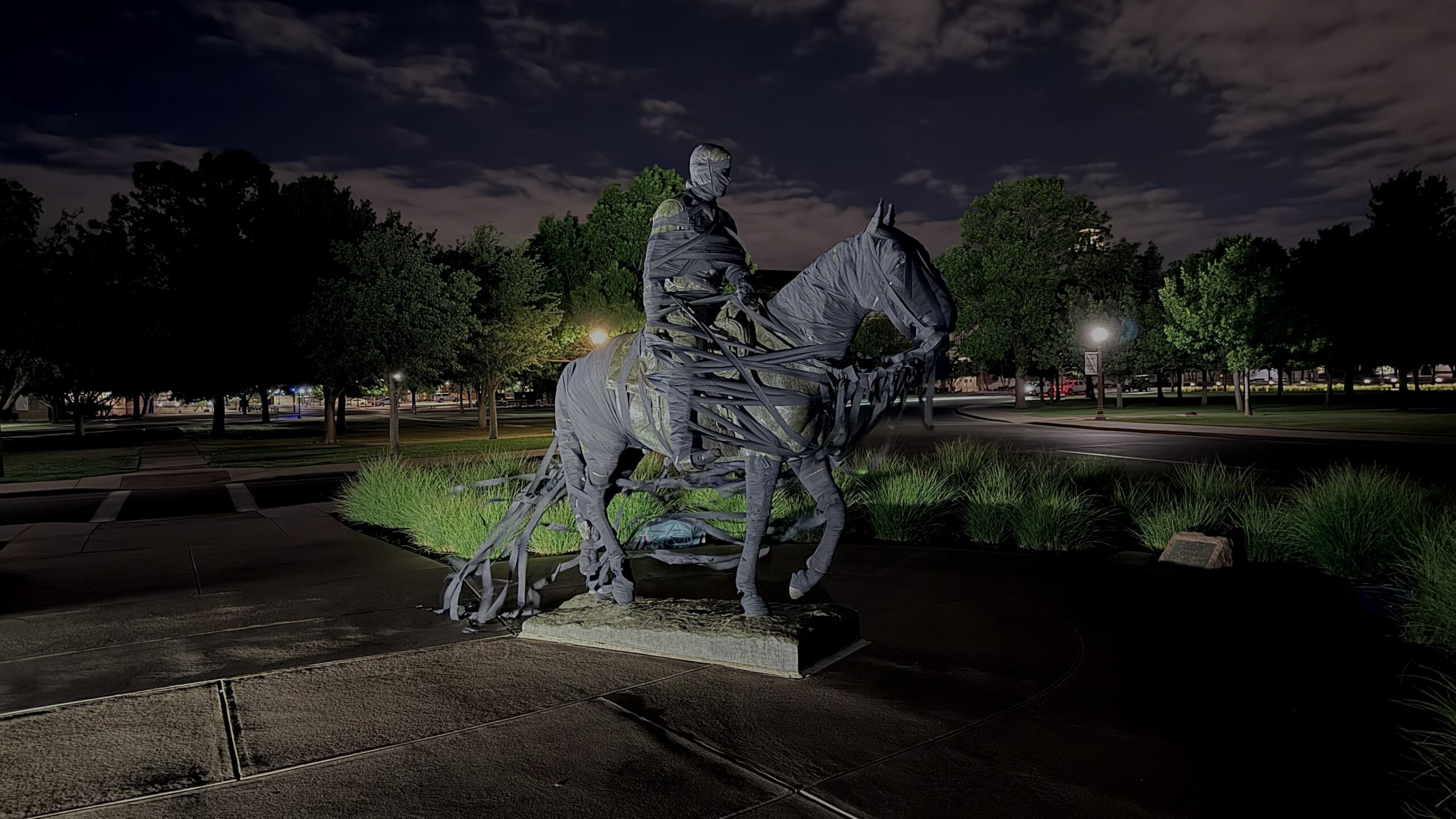
In December 2025 and April 2026, Texas Tech University System Chancellor Brandon Creighton issued two memoranda requiring faculty to disclose, and the Board of Regents to approve, course content touching on race, sex, sexual orientation, or gender identity before it could be taught; the second extended the same review to graduate research. During a university staff meeting about implementation of the restrictions, examples reportedly discussed as affected by the policy included Elsa from Frozen, Romeo and Juliet, Moby-Dick, and David Bowie.
On May 2, 2026, I created Bowie at Texas Tech: a site-specific video installation with sound, projecting David Bowie’s “Life on Mars?” onto the university’s red granite seal after dark. The work followed a staff meeting in which Bowie was identified among examples affected by the new restrictions, and addressed what those restrictions meant for the visibility of LGBTQ people, histories, and cultural figures on campus.
The two works function as a paired response. If the Bowie projection is an elegiac image — a cultural figure kept visible after dark — then wrapping the university’s Rider statue in black crepe transformed an institutional symbol into an object of mourning. Together, the interventions treated censorship not only as something to resist, but as something to mourn.
Four days later, on May 6, 2026, I created Death of Academic Freedom: a site-specific installation built from found objects and assemblage sculpture. Its subject was the Texas Tech Rider — the campus’s Will Rogers and Soapsuds statue — traditionally wrapped in red crepe paper before home football games. I wrapped it instead in black, a color the university has used only rarely, reserved for occasions of mourning and institutional significance, extending the same response to the university’s escalating restrictions on what its faculty can teach and, from that fall on, what its students could research and produce.
Unlike MOM air, We’re Sorry, and Wendy’s Iceland Inc, which spread through sustained press cycles, these two works moved first through Instagram and TikTok, amplified by allied accounts including Raiders Against Censorship. Across both platforms, they drew close to 600,000 combined views, reached over 270,000 accounts on Instagram alone, and generated more than 42,000 likes and roughly 4,700 shares within days — an organic, high-velocity reach that marks a further experiment in the systems through which the work circulates.
On July 8, 2026, the American Association of University Professors and Texas AAUP-AFT, represented by Lambda Legal, the NAACP Legal Defense and Educational Fund, and Davis Wright Tremaine, filed a federal lawsuit challenging the memoranda. The complaint alleges unconstitutional viewpoint discrimination and argues that the policies disproportionately affect Black and LGBTQ faculty, students, and scholarship.


Inside Higher Ed

PEN America

Lambda Legal
Category:
Concept and Performance